# Definition for singly-linked list. # class ListNode: # def __init__(self, x): # self.val = x # self.next = None class Solution: def mergeTwoLists(self, l1, l2): """ :type l1: ListNode :type l2: ListNode :rtype: ListNode """ head=None cur=None while l1 is not None or l2 is not None: if head is None: if l1 is not None and l2 is not None and l1.val<l2.val: head=l1 l1=l1.next cur=head elif l1 is not None and l2 is not None and l1.val>l2.val: head=l2 l2=l2.next cur=head elif l1 is None and l2 is not None: head=l2 l2=l2.next cur=head else: head=l1 l1=l1.next cur=head elif l1 is not None and l2 is not None and l1.val<l2.val: cur.next=l1 l1=l1.next cur=cur.next elif l1 is not None and l2 is not None and l1.val>l2.val: cur.next=l2 l2=l2.next cur=cur.next elif l1 is None and l2 is not None: cur.next=l2 l2=l2.next cur=cur.next else: cur.next=l1 l1=l1.next cur=cur.next return head
Tuesday, April 17, 2018
Beat 99.95% of submitted solutions for Merge Two Sorted Linked Lists
Yes, I did it again. Simple enough.
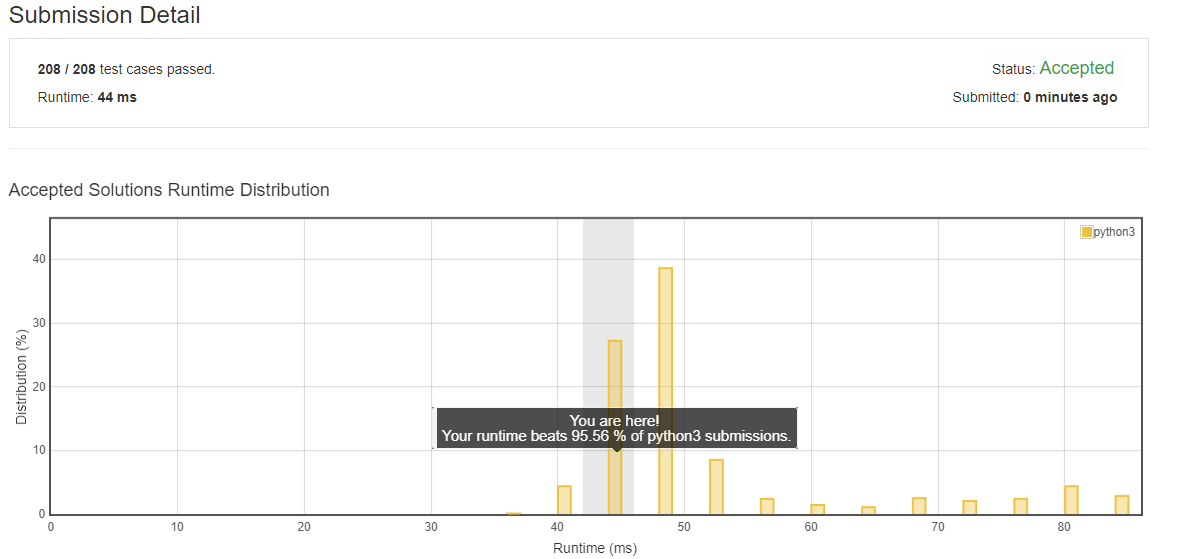
Monday, April 9, 2018
Beat 95.56% of python submissions
Good result. I'm happy.
# Definition for singly-linked list. # class ListNode: # def __init__(self, x): # self.val = x # self.next = None class Solution: def removeNthFromEnd(self, head, n): """ :type head: ListNode :type n: int :rtype: ListNode """ count=0 tmp=list() cur=head while cur is not None: # if count>n: # break tmp.append(cur) cur=cur.next count+=1 if count==1 and n==1: return None if n==1: tmp[len(tmp)-n-1].next=None return head if n==len(tmp): head=None head=tmp[1] return head if n>0: tmp[len(tmp)-n-1].next=tmp[len(tmp)-n+1] return head if __name__ =='__main__': s=Solution() class ListNode: def __init__(self, x): self.val = x self.next = None self.head=self def add_to_the_end(self, val): cur=self.head while cur.next is not None: cur=cur.next cur.next=ListNode(val) def printLinkedList(self): cur =self.head while cur is not None: print (cur.val) cur=cur.next ln=ListNode(1) ln.add_to_the_end(2) ln.add_to_the_end(3) ln.add_to_the_end(4) ln.add_to_the_end(5) s.removeNthFromEnd(ln,5) ln.printLinkedList()
Monday, March 12, 2018
Beat 100% of python3 submissions
Yes! I did it.
Here is simple code that gives me performance described on picture above.
class powxy: def pow(self, x, n): if n == 0.0: return 1 if n < 0: n = -n x = 1/x if n % 2 == 0: return self.pow(x*x, int(n/2)) return x*self.pow(x*x, int(n/2))
Tuesday, March 6, 2018
How to use virtual invironment in python 3.6
A Virtual Environment, allows to create an isolated working copy of Python. It is quite common situation when Python applications use packages that are not part of the standard library. It happens that multiple applications may require different version of the same library. In other words- single installation of Python will not be able to serve all the possible requirements for applications. This issue can be solved by utilizing Virtual environments. Virtual environment is directory that contains all the Python installation and all the required packages. Different Python application may use dedicated virtual environments.
Starting Python 3.6 - virtual environment creation module shipped as part of Python installation.
Here is example - how to create virtual environment using Python 3.6
This command creates new forlder "env" in current directory (if directory not yet exists). It also create subdirectories in "env" directory that containing a copy of the Python interpreter, the standard library, supporting files, etc.
After virtual environment is created- it needs to be activated:
Depend on OS type- it can be done in several ways.
For Windows:
For Linux:
After virtual environment is activated- shell will show activated virtual environment as a prefix in command prompt: (venv).
Now we can install all the required libraries for our current Python application.
For example:
All the installed packages will be stored inside of "venv" folder and not overlap/affect any other Python applications.
v
Starting Python 3.6 - virtual environment creation module shipped as part of Python installation.
Here is example - how to create virtual environment using Python 3.6
python -m venv env
This command creates new forlder "env" in current directory (if directory not yet exists). It also create subdirectories in "env" directory that containing a copy of the Python interpreter, the standard library, supporting files, etc.
After virtual environment is created- it needs to be activated:
Depend on OS type- it can be done in several ways.
For Windows:
.\env\Scripts\activate.bat
For Linux:
./env/Scripts/activate.sh
After virtual environment is activated- shell will show activated virtual environment as a prefix in command prompt: (venv).
Now we can install all the required libraries for our current Python application.
For example:
python -m pip install beautifulsoup4
python -m pip install lxml
All the installed packages will be stored inside of "venv" folder and not overlap/affect any other Python applications.
v
Thursday, February 2, 2017
Vertx: How to write log file using JavaScript
For those who are not familiar with Vertx- its tool-kit for building reactive applications on the JVM.
It make sense to start with introduction to Vertx, but it's already done by many other guys in internet. I'll share here few code snippets that I wrote using Vertx in JavaScript.
I would like to admit one important thing: Vertx runs on JVM- which means- we can get access to entire Java ecosystem from any language that supported by Vertx.
Now let's get back to our main topic: how to write log file using Vertx in JavaScript?
Here is code snippet of mylog.js:
We have to include mylog.js file in main application to start using it.
Pretty simple.
It make sense to start with introduction to Vertx, but it's already done by many other guys in internet. I'll share here few code snippets that I wrote using Vertx in JavaScript.
I would like to admit one important thing: Vertx runs on JVM- which means- we can get access to entire Java ecosystem from any language that supported by Vertx.
Now let's get back to our main topic: how to write log file using Vertx in JavaScript?
Here is code snippet of mylog.js:
1 2 3 4 5 6 7 8 9 10 11 12 13 14 15 16 17 18 19 20 21 22 23 24 25 26 27 28 29 30 31 32 33 34 35 36 37 38 39 40 41 42 43 44 45 46 47 48 49 50 51 52 53 54 55 56 57 58 59 60 61 62 63 64 65 | var fw = null;//log file handler var logFile=null; var $logEnabled=null; var $logPath=null; var $maxLogFileSize=null; //create Text file using java.io.FileWriter and java.io.File this.createLogFile =function(){ var FileWriter=Java.type("java.io.FileWriter"); fw = new FileWriter($logPath); var File= Java.type("java.io.File"); logFile=new File($logPath); } function closeLogFile(){ fw.close(); } //write to log file function append(msg){ var curDate=new Date(); msg=curDate+':'+msg; var fileSize=logFile.length(); console.log('file size='+fileSize); if(fileSize>$maxLogFileSize){ //rotation for log file based on size value console.log('rewrite file from scratch'); closeLogFile();//close file createLogFileHandler()//recreate file fw.write(msg); fw.write("\n"); } else { fw.append(msg); fw.append("\n"); } fw.flush(); } //set initial values to variables this.construct= function(){ $logEnabled=true; $logPath="/var/tmp/test.log"; $maxLogFileSize=1000000; } //public method available from main program this.log=function(msg){ msg=msg.toString()+'\n '; if($logEnabled){ if($logPath!==null){ appendToExistingLogFile(msg); } else console.log("log file path is not defined- unable to write into file"); } else console.log(msg); } |
We have to include mylog.js file in main application to start using it.
1 2 3 4 5 6 7 | require("mylog.js"); construct(); createLogFile(); log("Hello world"); |
Pretty simple.
Thursday, October 31, 2013
Project Euler. Longest Collatz sequence. Problem 14 solution in C++
Collatz conjecture it's open mathematical problem. Still not proved.
Here is rules for generating Collatz sequence:
n → n/2 (n is even)
n → 3n + 1 (n is odd)
Problem 14 contains a question:Which starting number, under one million, produces the longest chain?
I decided to play with C++ little bit and utilize CPU cores. So my solution written using C++ and multithreading programming.
Current NUM_THREADS= 5 T tried different numbers of threads- but 5 thread - achieved best time result.
According to lscpu I have 6 cores only, so I'm not really sure if I understood why 5 threads calculate result faster then 6 threads.
Here is rules for generating Collatz sequence:
n → n/2 (n is even)
n → 3n + 1 (n is odd)
Problem 14 contains a question:Which starting number, under one million, produces the longest chain?
I decided to play with C++ little bit and utilize CPU cores. So my solution written using C++ and multithreading programming.
//============================================================================ // Name : LongestCollatzSequence.cpp // Author : // Version : // Copyright : Your copyright notice // Description : Hello World in C++, Ansi-style //============================================================================ #include <iostream> #include <cstdlib> #include <pthread.h> #include <sys/time.h> #include <ctime> using namespace std; long maxVal=0; long actualNumber=0; #define NUM_THREADS 5 #define LIMIT 1000000 pthread_mutex_t lock; typedef unsigned long long timestamp_t; static timestamp_t get_timestamp () { struct timeval now; gettimeofday (&now, NULL); return now.tv_usec + (timestamp_t)now.tv_sec * 1000000; } long calcNCount(long n) { long result = n; if (result <= 1) return 1; if (result % 2 == 0) return 1+calcNCount(result/2); return 1+calcNCount(3*result+1); } void* DoJob(void* num){ long result=calcNCount((long)num); pthread_mutex_lock(&lock); if(result>maxVal){ maxVal=result; actualNumber=(long)num; } pthread_mutex_unlock(&lock); pthread_exit(NULL); } int main() { timestamp_t t0 = get_timestamp(); if (pthread_mutex_init(&lock, NULL) != 0) { cout<<"\n mutex init failed\n"; return 1; } pthread_t threads[NUM_THREADS]; pthread_attr_t attr; void *status; int rc; // Initialize and set thread joinable pthread_attr_init(&attr); pthread_attr_setdetachstate(&attr, PTHREAD_CREATE_JOINABLE); long i=1; while(i<LIMIT){ int countThreads=0; for(int j=0; j < NUM_THREADS; j++ ){ i++; if(i<LIMIT){ rc = pthread_create(&threads[j], NULL, DoJob, (void *)i ); if (rc){ cout << "Error:unable to create thread," << rc << endl; exit(-1); } countThreads++; } else break; } for( int j=0; j < countThreads; j++ ){ rc = pthread_join(threads[j], &status); if (rc){ cout << "Error:unable to join," << rc << endl; exit(-1); } } //cout<<"processed:"<<i<<endl; } pthread_mutex_destroy(&lock); // free attribute and wait for the other threads pthread_attr_destroy(&attr); timestamp_t t1 = get_timestamp(); double secs = (t1 - t0) / 1000000.0L; cout<<"time elapsed="<<secs<<endl; cout<<"result:"<<actualNumber<<endl; pthread_exit(NULL); }
Current NUM_THREADS= 5 T tried different numbers of threads- but 5 thread - achieved best time result.
According to lscpu I have 6 cores only, so I'm not really sure if I understood why 5 threads calculate result faster then 6 threads.
Project Euler. Problem 13. Large Sum Solution in C#
What a lovely pretty solution.
BigInteger sum=0; foreach(var line in File.ReadAllLines("data")) sum+=(BigInteger.Parse(line)); Console.WriteLine(sum.ToString().Substring(0,10));
Saturday, October 26, 2013
Problem 12. Highly divisible triangular number implementation in C++
Hi,
today, I going to show solution of one more problem from http://projecteuler.net.
What is triangular numbers? A triangular number or triangle number counts the objects that can form an equilateral triangle. Please refer Wikipedia for additional information.
In general, triangular number can be calculated using formula bellow
So here is rough solution. It's working, but it will take forever to complete. :)
Sure, you can use threads to improve performance, but it's not help you too much.
We shouldn't calculate and count prime numbers for required number, we can simplify by using square root .
This solution works so fast, comparing to previous, brute force solution.
Less then 1 second- incredible performance.
How can we improve it even more?
Lets try to rewrite all this things using thread.
Because of a task solving time cost relative small, threads wouldn't help you here.
In my case time execution even increased, because of a lot of threads handling routines.
I've did several tests, and result still not so good as without threads.
But anyway- its a good experience.
today, I going to show solution of one more problem from http://projecteuler.net.
What is triangular numbers? A triangular number or triangle number counts the objects that can form an equilateral triangle. Please refer Wikipedia for additional information.
In general, triangular number can be calculated using formula bellow
triangleNumber=n*(n+1)/2;
So here is rough solution. It's working, but it will take forever to complete. :)
Sure, you can use threads to improve performance, but it's not help you too much.
//============================================================================ // Name : HighlyDivisibleTriangularNumber.cpp // Author : // Version : // Copyright : Your copyright notice // Description : Hello World in C++, Ansi-style //============================================================================ #include <iostream> #include <sys/time.h> #include <ctime> #include<math.h> using namespace std; int coutDividers(const long num){ int tmp=1; for(long i=1; i<num; i++) if(num% i==0)tmp++; return tmp++; } typedef unsigned long long timestamp_t; static timestamp_t get_timestamp () { struct timeval now; gettimeofday (&now, NULL); return now.tv_usec + (timestamp_t)now.tv_sec * 1000000; } int main() { timestamp_t t0 = get_timestamp(); //n(n+1) /2 int counter=1; long triangleNumber=1l; int dividers=0; while (dividers<=500){ triangleNumber=counter*(counter+1)/2; dividers=coutDividers(triangleNumber); //cout<<triangleNumber<<"="<<dividers<<endl; counter++; } cout<<triangleNumber<<"="<<dividers<<endl; timestamp_t t1 = get_timestamp(); double secs = (t1 - t0) / 1000000.0L; cout<<"time elased="<<secs<<endl; return 0; }
We shouldn't calculate and count prime numbers for required number, we can simplify by using square root .
//============================================================================ // Name : HighlyDivisibleTriangularNumber.cpp // Author : // Version : // Copyright : Your copyright notice // Description : Hello World in C++, Ansi-style //============================================================================ #include <iostream> #include <sys/time.h> #include <ctime> #include<math.h> using namespace std; int coutDividers(const long num){ int tmp=1; for(long i=1; i<sqrt(num); i++) if(num% i==0)tmp++; return (tmp++)*2; } typedef unsigned long long timestamp_t; static timestamp_t get_timestamp () { struct timeval now; gettimeofday (&now, NULL); return now.tv_usec + (timestamp_t)now.tv_sec * 1000000; } int main() { timestamp_t t0 = get_timestamp(); //n(n+1) /2 int counter=1; long triangleNumber=1l; int dividers=0; while (dividers<=500){ triangleNumber=counter*(counter+1)/2; dividers=coutDividers(triangleNumber); //cout<<triangleNumber<<"="<<dividers<<endl; counter++; } cout<<triangleNumber<<"="<<dividers<<endl; timestamp_t t1 = get_timestamp(); double secs = (t1 - t0) / 1000000.0L; cout<<"time elased="<<secs<<endl; return 0; }
This solution works so fast, comparing to previous, brute force solution.
Less then 1 second- incredible performance.
How can we improve it even more?
Lets try to rewrite all this things using thread.
//============================================================================ // Name : HighlyDivisibleTriangularNumberMultithreaded.cpp // Author : // Version : // Copyright : Your copyright notice // Description : Hello World in C++, Ansi-style //============================================================================ #include <iostream> #include <cstdlib> #include <pthread.h> #include <unistd.h> #include <sys/time.h> #include <ctime> #include<math.h> using namespace std; #define NUM_THREADS 6 pthread_mutex_t lock; long searchResult=0l; long searchDividers=0l; typedef unsigned long long timestamp_t; static timestamp_t get_timestamp () { struct timeval now; gettimeofday (&now, NULL); return now.tv_usec + (timestamp_t)now.tv_sec * 1000000; } void* coutDividers(void* num){ int tmp=1; long dest=(long)num; for(long i=1; i<sqrt(dest); i++) if(dest% i==0)tmp++; pthread_mutex_lock(&lock); if(searchResult==0l){ if(tmp*2>=500){ searchResult=dest; searchDividers=tmp*2; } } pthread_mutex_unlock(&lock); pthread_exit(NULL); } int main () { timestamp_t t0 = get_timestamp(); if (pthread_mutex_init(&lock, NULL) != 0) { cout<<"\n mutex init failed\n"; return 1; } int counter=1; long triangleNumber=1l; while (true){ int rc; int i; pthread_t threads[NUM_THREADS]; pthread_attr_t attr; void *status; // Initialize and set thread joinable pthread_attr_init(&attr); pthread_attr_setdetachstate(&attr, PTHREAD_CREATE_JOINABLE); for( i=0; i < NUM_THREADS; i++ ){ triangleNumber=counter*(counter+1)/2; counter++; rc = pthread_create(&threads[i], NULL, coutDividers, (void *)triangleNumber ); if (rc){ cout << "Error:unable to create thread," << rc << endl; exit(-1); } } // free attribute and wait for the other threads pthread_attr_destroy(&attr); for( i=0; i < NUM_THREADS; i++ ){ rc = pthread_join(threads[i], &status); if (rc){ cout << "Error:unable to join," << rc << endl; exit(-1); } } pthread_mutex_lock(&lock); if(searchResult>0l){ cout<<"searchResult="<<searchResult<<endl<<"searchDividers="<<searchDividers<<endl; timestamp_t t1 = get_timestamp(); double secs = (t1 - t0) / 1000000.0L; cout<<"time elapsed="<<secs<<endl; pthread_exit(NULL); pthread_mutex_destroy(&lock); } pthread_mutex_unlock(&lock); } cout << "Main: program exiting." << endl; pthread_exit(NULL); }
Because of a task solving time cost relative small, threads wouldn't help you here.
In my case time execution even increased, because of a lot of threads handling routines.
I've did several tests, and result still not so good as without threads.
But anyway- its a good experience.
Monday, October 21, 2013
Largest product in a grid algorithm implementation in C#
Hi,
A few days ago I started practicing in problem solving. I've picked projecteuler for this purpose.
I think it would be great to share some interesting solutions in my blog.
Problem 11. Largest product in a grid
Nothing special, just a good example to show you a complex "for" loop, nothing else.
So here is algorithm:
That's all, feel free post your comments.
A few days ago I started practicing in problem solving. I've picked projecteuler for this purpose.
I think it would be great to share some interesting solutions in my blog.
Problem 11. Largest product in a grid
Nothing special, just a good example to show you a complex "for" loop, nothing else.
So here is algorithm:
- Do loop through matrix, for each cell
- Calculate horizontal product and check if it's largest product for now
- Calculate vertical product and check if it's largest product for now
- Calculate Right diagonal and check if it's largest product for now
- Calculate left diagonal and check if it's largest product for now
using System; namespace LargestProductInGrid { public class Solver { private int largestProduct=Int32.MinValue; private const int SIZE=20; private const int COUNT=4; private int[,] m=new int[SIZE,SIZE] {{08, 02, 22, 97, 38, 15, 00, 40, 00, 75, 04, 05, 07, 78, 52, 12, 50, 77, 91, 08}, {49, 49, 99, 40, 17, 81, 18, 57, 60, 87, 17, 40, 98, 43, 69, 48, 04, 56, 62, 00}, {81, 49, 31, 73, 55, 79, 14, 29, 93, 71, 40, 67, 53, 88, 30, 03, 49, 13, 36, 65}, {52, 70, 95, 23, 04, 60, 11, 42, 69, 24, 68, 56, 01, 32, 56, 71, 37, 02, 36, 91}, {22, 31, 16, 71, 51, 67, 63, 89, 41, 92, 36, 54, 22, 40, 40, 28, 66, 33, 13, 80}, {24, 47, 32, 60, 99, 03, 45, 02, 44, 75, 33, 53, 78, 36, 84, 20, 35, 17, 12, 50}, {32, 98, 81, 28, 64, 23, 67, 10, 26, 38, 40, 67, 59, 54, 70, 66, 18, 38, 64, 70}, {67, 26, 20, 68, 02, 62, 12, 20, 95, 63, 94, 39, 63, 08, 40, 91, 66, 49, 94, 21}, {24, 55, 58, 05, 66, 73, 99, 26, 97, 17, 78, 78, 96, 83, 14, 88, 34, 89, 63, 72}, {21, 36, 23, 09, 75, 00, 76, 44, 20, 45, 35, 14, 00, 61, 33, 97, 34, 31, 33, 95}, {78, 17, 53, 28, 22, 75, 31, 67, 15, 94, 03, 80, 04, 62, 16, 14, 09, 53, 56, 92}, {16, 39, 05, 42, 96, 35, 31, 47, 55, 58, 88, 24, 00, 17, 54, 24, 36, 29, 85, 57}, {86, 56, 00, 48, 35, 71, 89, 07, 05, 44, 44, 37, 44, 60, 21, 58, 51, 54, 17, 58}, {19, 80, 81, 68, 05, 94, 47, 69, 28, 73, 92, 13, 86, 52, 17, 77, 04, 89, 55, 40}, {04, 52, 08, 83, 97, 35, 99, 16, 07, 97, 57, 32, 16, 26, 26, 79, 33, 27, 98, 66}, {88, 36, 68, 87, 57, 62, 20, 72, 03, 46, 33, 67, 46, 55, 12, 32, 63, 93, 53, 69}, {04, 42, 16, 73, 38, 25, 39, 11, 24, 94, 72, 18, 08, 46, 29, 32, 40, 62, 76, 36}, {20, 69, 36, 41, 72, 30, 23, 88, 34, 62, 99, 69, 82, 67, 59, 85, 74, 04, 36, 16}, {20, 73, 35, 29, 78, 31, 90, 01, 74, 31, 49, 71, 48, 86, 81, 16, 23, 57, 05, 54}, {01, 70, 54, 71, 83, 51, 54, 69, 16, 92, 33, 48, 61, 43, 52, 01, 89, 19, 67, 48}}; public Solver () { } public int GetLargestProductInGrid() { int tmp=0; for(int i=0; i<SIZE; i++) for(int j=0; j<SIZE; j++) { tmp=this.HorizontalProduct(i,j); if(tmp>this.largestProduct) this.largestProduct=tmp; tmp=this.VerticalProduct(i,j); if(tmp>this.largestProduct) this.largestProduct=tmp; tmp=this.DiagonalRight(i,j); if(tmp>this.largestProduct) this.largestProduct=tmp; tmp=this.DiagonalLeft(i,j); if(tmp>this.largestProduct) this.largestProduct=tmp; } return this.largestProduct; } private int HorizontalProduct(int i, int j) { int result=1; for(int k=i; (k<i+COUNT &&k<SIZE); k++) result=result*m[j,k]; return result; } //[column, row] private int DiagonalRight(int i, int j) { int result=1; for (int n=i, k=j; (n<i+COUNT &&n<SIZE && k<j+COUNT &&k<SIZE); n++, k++) result=result*m[n,k]; return result; } //[column, row] private int DiagonalLeft(int i, int j) { int result=1; for (int n=i, k=j; (n>i-COUNT &&n<SIZE && n>0 && k<j+COUNT &&k<SIZE); n--, k++) result=result*m[n,k]; return result; } private int VerticalProduct(int i, int j) { int result=1; for(int k=i; (k<i+COUNT &&k<SIZE); k++) result=result*m[k,j]; return result; } } }
That's all, feel free post your comments.
Subscribe to:
Posts (Atom)